Clever Corvids

I am one of those zoologists whom is hyper fixated on a certain group of animals, to an alarmingly obsessive degree. My animals of interest are corvids, or members of the raven family such as crows, rooks, jays etc. I am fascinated by their intelligence and cognitive skills, and revel in stories about the clever crow who figured out how to crack nuts using cars, or the raven who can talk, or the jays who can remember where they stored food from months ago. On a recent hunt for new studies on my avian friends I came across a paper on social intelligence in common ravens (Corvus corax)[1].

Many a study in the past has highlighted the adept intelligence and skill of common ravens. They are good problem solvers; one of Aesops’ famous fables involves a raven dropping stones into a tube of water to bring the water level up so it may drink, a practise they are known to repeat in lab conditions. Further than that, they are one of a few species known to demonstrate displacement: they can communicate about objects or events occurring in a separate space or time. They are also one of few species known to play purely for fun. They have been seen sliding down snow banks and playing catch-me-if-you-can with other species such as wolves. The new study I came across corroborates a lot of this knowledge on raven intelligence, and presents an argument for how their social landscape might have given rise to it.

Like many birds, ravens often form flocks (or as they are known by their collective noun, an unkindness) of conspecifics, of which there can be members from multiple different life stages. There may often be breeding pairs, as ravens form monogamous bonds, but there may also be juveniles or other non-breeders in the group. It is this complex social web that sets the stage for some fascinating social interactions to take place.

Take for example the non-breeders. Ravens have a period of their life stage as juveniles where they are not yet sexually mature enough to breed, but are old enough to have left the nest. These birds often aggregate together in flocks, and cooperate in predator vigilance and in gaining access to food that is monopolised by territorial breeding pairs. Social intelligence plays some key roles in these interactions. In the study they corroborated evidence from previous studies that demonstrates ravens will respond to calls from groups that they had been previously associated with. Not only that, but they could differentiate between calls from ravens that were their previous affiliates and those that were not, and respond accordingly. In pair tasks, they are more likely to work with affiliates than non-affiliates. For these non-breeders, cooperation is important in their social landscape. But so too is competition.

Like many species, including some of our close relatives, the chimps (Pan troglodytes), ravens form ranks based on a dominance hierarchy. Ranks are not fixed, and birds will sometimes compete for higher spots in the social order. Not only have ravens in previous experiments demonstrated an understanding of their own social rank, they also understand the ranking of others even when they are not involved in that relationship themselves; a so-called third party understanding. A competitive social landscape can also develop an awareness of self, as ravens have somewhat demonstrated in their ability to “lie” about where they’re storing food when they know others are watching.

So what?

This research paper may not be bringing any new experimental designs for birds to the table, but it outs into perspective what many years of research into corvid cognition has meant in terms of our understanding of their intelligence. In short, birds (particularly corvids) are far more intelligent than we give them credit for. They are often overlooked in intelligence discussions; we are often biased towards studies on mammals, particularly non-human primates. We like to think complex social structures are something rather unique to us but they aren’t. This study demonstrates that ‘societies’ can arise in many different species, no just those related to us. It also shows a convergence in evolution to solving the problems this landscape brings, in cognitive traits such as long term memory and awareness of self. I hope further research continues to be published such as this that highlights, that though we may be the dominant species, the traits that we exalt ourselves in having are not unique to us, and that brilliance shines throughout all species.

Sources

[1] https://link.springer.com/article/10.1007/s00265-018-2607-2#Sec10
Ignorance is Bliss, but that doesn’t make it Safe

At the beginning of March, we in the UK experienced two winter storms over the course of only a few weeks. Gareth and Hannah, names designed to evoke fear and terror, generated 40-70mph winds, churned up the Atlantic ocean, and even unfortunately killed 3 climbers in an avalanche on Ben Nevis [1]. All of this during the beginning of spring, a time when weather is supposed to be warming up, when storms are supposed to cease for a while. So what does this mean? Its cold and miserable when its supposed to be warm? The answer is obvious! Global warming is a myth!

If you haven’t already clicked off this blog post in anger, you should know I’m joking. Climate is not the same thing as weather; if anything freak storms are evidence of climate change in action[2]. But you’d be surprised how often people are convinced by arguments such as this. So much so that the very idea that climate change is occurring is seen as a controversial topic.

Why do people deny it?

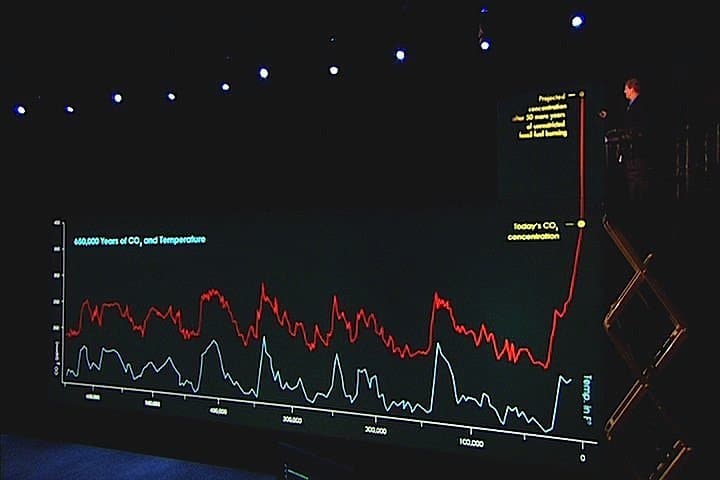
When I was around 12 years old I got into an argument with a woman about climate change. She said she didn’t believe in global warming, in recycling and energy reduction, because “the world has been changing all the time, it’s not like this is any different now.” This is one of the classic arguments people like to use. Its happened in the past, so why is this any different now? Why should we worry? Why should I care? Well sure, it’s happened in the past. But the last time there was a dramatic shift in global climate it killed off the megafauna. Have you seen a mammoth recently? If you’ve ever seen An Inconvenient Truth, or even done a smidge on research on the subject you’ll know greenhouse gas emissions have increased exponentially since the 1900s[3]. There are 7 billion people on the planet, currently generating over 35 billion tonnes of carbon a year[3]. You can hope that it’s not going to make a difference, and that we’ll all be fine, but considering recent research has highlighted current government policy for reducing global temperature may still not be enough to stop the ice caps melting[4], maybe you should consider that it’s time to stop avoiding the truth.

Image result for an inconvenient truth
From Al Gore’s An Inconvenient Truth. CO2 levels today are much higher than prehistoric fluctuations.

For many, it’s easier to ignore the evidence. Its quite human really, to not pay too much mind to consequences that will not happen in your lifetime. Foresight can be difficult to grasp, and if your house wasn’t blown away by a hurricane or ravaged by wildfire, or swept away by a flood, it can be easier sometimes to look the other way. This is certainly the attitude of many of the older generation. They will not live long enough to deal with the consequences, so for them ignoring the threat is easy. But for the younger generations, this is an attitude we are getting quite tired of. Recently, students around the world have been going on strike, boycotting classes to protest the lack of effort put to preventing global warming. More than 1.4 million took part in the event, from 128 different countries[5]. The inspiration for the strikes, 16 year old Greta Thunberg, has even been nominated for a Nobel peace prize[6]. The message from such protest is clear: we are of ignorance of the truth at our expense, and we refuse to sit back and let it happen.

What’s the worst that could happen?

The World Health Organisation lists climate change as one of the biggest threats to global public health in 2019[7]. Between 2030 and 2050 climate change is expected to cause an estimated 250,000 additional deaths, from factors such as malnutrition, malaria and heat stress[8]. That’s not including numbers who die from natural disasters, i.e. hurricanes, flash floods, wildfires etc. which have more than tripled in annual frequency since the 60s[8].

If climate change were to be ignored, and we enacted the “business as usual” approach, the worst that would happen is that the most vulnerable would be the first to die, and in the biggest numbers. Much of the worlds developing countries are in the tropics, which also happens to be the area with the greatest increase in frequency and severity of natural disasters due to climate change[9]. Communities here do not have the resources or infrastructure to deal with freak weather events. Take the recent cyclone Idai that struct communities in Mozambique and Zimbabwe. More than 1,000 people are estimated to have died during, and as it continues to rain more still may be affected by flooding[10]. To ignore climate change is a western privilege. We do not have to feel the worst effects.

Related image
Destruction left in the wake of the recent Cyclone Idai.

Politiclash

The greatest obstacle in the way of progress against climate change is more often than not within the politics of the issue. Climate change is by deniers often treated like a national issue more than a global one. Reducing greenhouse emissions won’t reduce poverty. Reducing emissions is not more important than building the economy. Even the current President of the United states once famously tweeted “The concept of Global Warming was created by and for the Chinese in order to make U.S. manufacturing non-competitive”. Climate change is a tool used for dividing people, when the opposite should be true.

Image result for The concept of Global Warming was created by and for the Chinese in order to make U.S. manufacturing non-competitive
Yes, he really did say that.

The threat of global warming and climate change should be fuel to unite us as a species, not divide us. Its not a case of the US vs China, or democrats vs republicans or whoever they are against us. Its all of us, against the problems we are all responsible for that are destroying our planet. It will take a lot of work sure, but we will make so much more progress listening to scientists and enacting change now then sticking our fingers in our ears and hoping it goes away. And to scientists I say, get involved in politics if you want to make a difference. If we want to be heard, we have to be willing to put our selves out there and make people listen.

Sources

[1] https://www.telegraph.co.uk/news/2019/03/12/uk-weather-storm-gareth-batters-britain-heavy-rain-gale-force/

[2] https://www.theguardian.com/environment/2018/jul/27/extreme-global-weather-climate-change-michael-mann

[3] https://ourworldindata.org/grapher/annual-co-emissions-by-region

[4] https://www.nature.com/articles/s41586-019-0889-9

[5] https://www.theguardian.com/environment/2019/mar/19/school-climate-strikes-more-than-1-million-took-part-say-campaigners-greta-thunberg

[6] https://www.theguardian.com/world/2019/mar/14/greta-thunberg-nominated-nobel-peace-prize   

[7] https://www.who.int/emergencies/ten-threats-to-global-health-in-2019

[8] https://www.who.int/news-room/fact-sheets/detail/climate-change-and-health

[9] https://www.economist.com/graphic-detail/2018/05/09/climate-change-will-affect-developing-countries-more-than-rich-ones

[10] https://www.economist.com/middle-east-and-africa/2019/03/21/tropical-cyclone-idai-may-have-killed-more-than-1000-in-mozambique

Geese Are Annoying

If I didn’t have a sense of obligation to promoting good science practises I’d be reiterating these words to every biology freshman I came across: don’t work with animals in the field. Wherever possible, don your white coat and stick an animal in a lab. That way, you get to stay indoors, in the warm, where it’s well lit. There’s no risk of your research animal running away, or just not being there. Alas, in science we don’t always have the luxury of comfortable research. And unfortunately for me in the case of my masters research, a Canada goose does not fit in a petri dish.

I make jokes about how miserable field research can be but in reality, it is where I choose to be. My interest in zoology is in cognition and behaviour, particularly that of birds. So when the opportunity came to study goose behaviour for my masters project it, I immediately jumped at it. See, birds have only recently begun to be recognised for their cognitive abilities. Research into learning, social intelligence, memory and the like is very new for many avian species, and for some, like my research animal the humble Canada goose (Branta canadensis), it is non-existent. This lack of research is what led me to base my research project around the learning and memory capabilities of Canada geese.

In my decent down the rabbit hole of research papers I came across a paper on Greylag geese (Anser anser)[1]. The researchers had managed to train the geese to learn a sequence of coloured cups (A-E) which when placed next to each other pairwise would either contain food or be empty. For example, B is empty when next to A, but full when next to C and so on. Not only that, the researchers also tested how well the Greylags could remember the sequence after a few months and found that, even after half a year had passed the geese were still pretty accurate at picking the food-containing cup. This paper became the main inspiration for my research. Could I use the same kind of methods they used to test the memory  and learning capabilities of a Canada goose?

Did it work?

No. If you were wondering why I spent my first paragraph whining about field research, it’s because as it turns out testing a new research idea on animals in a non-controlled environment is rather difficult. Within my first few preliminary trials I realised my research would be hampered by the simple fact that the geese are seemingly afraid of plastic cups. They wouldn’t go near the things. Thirty minutes standing out in the cold in the middle of winter and nothing. Luckily for me, my project supervisor is nothing if not persistent. When I came to her dejected with the news my experiment was not going to worked, she jumped up and said “Brilliant! We’ve learned something new about them. Why not make your project based on that?” so that is what I did.

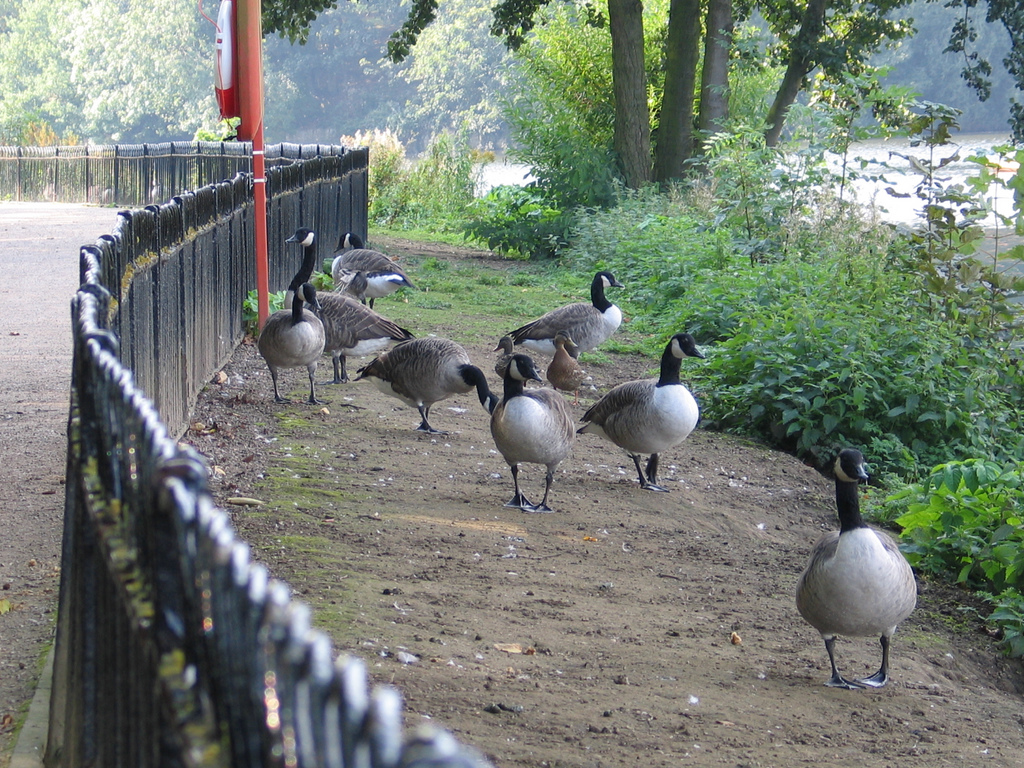
Now, my project is looking at the variance in neophobic responses to different types of containers. Something my supervisor pointed out is that perhaps they avoided eating from the cup because they would have to duck their heads into it (no pun intended), meaning their sight would be impeded. As herbivorous prey animals they rather rely on sight as they’re feeding to watch out for predators (or in their case, dogs). So my experimental trials were set up with six different shapes and sizes of container, to examine which factors might influence neophobic behaviours.

I’m not going to bore you with the details of what happened in each of the trials, but suffice to say even when you have a plan, you have all your equipment and you’re fully prepared, things can still go wrong. Mother nature delights in testing me. On multiple occasions my experimental equipment has blown away, and I have had the pleasure of chasing after it. Other days it has rained during the trial, soaking my notepad in the process. Because the flocks of geese are on publicly owned land, I also have the joy of dealing with the common folk. More than once people have stopped nearby to take pictures of the geese, some have even walked right through the trial, treading on the equipment seemingly oblivious. I have heard many hushed whispers behind my back of people asking “what’s going on here?” and “is that meant to be there or is it litter?” and of course “what’s that girl doing sitting watching the geese?”. I’m surprised I haven’t yet been reported to campus security.

So what’s the point?

I wouldn’t be surprised if I’ve perhaps put people off the idea of doing research in the field, but for the record that is not my intention. As many gripes there are to working in the field, I would rather spend all my days searching grass for bugs, or noting the species of birds I come across, or watching geese for hours than stuck in a lab looking down a microscope.

The true value of field research is that it allows one to watch the real natural world unfold around you. I love field research. There’s a sense of rawness to it. In science we can record all manners of behavioural interactions in a laboratory, but to rely solely on this  would only generate half the picture. One can understand so much more about how geese interact with each other and their environment by watching them in the field than one ever could sticking them in a white room. The skills I will obtain from my field research I also believe are invaluable in science. It prepares you to face the reality that in science you are never truly prepared; something will inevitably go wrong, and it forces you to find a solution and work around the problem.

Sources

[1] https://link.springer.com/article/10.1007/s10071-012-0554-2

canada goose
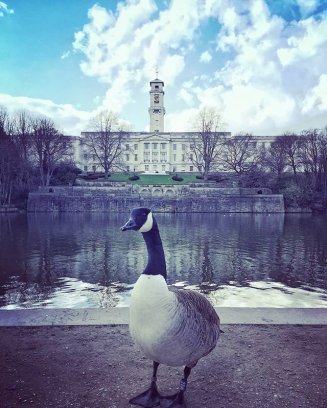
The humble Canada goose, stood watchful over the University of Nottingham’s Trent Building.